///////////
Wonders & Trivia

Is It Safe To Stand Near A Microwave?

Is It Safe To Stand Near A Microwave?

Most people step back when they press start. The instinct is understandable and the physics does not really support it.
Is It Safe To Stand Near A Microwave?

Almost everyone does it. Press start, take a step back, come forward when it beeps. Nobody taught us this. It just feels sensible.

The physics is less dramatic than the instinct.

It is not that kind of radiation

The word radiation is doing all the frightening work here, and it covers two very different things. Ionising radiation, such as X-rays and gamma rays, carries enough energy to knock electrons off atoms and damage DNA. Microwaves are non-ionising. They sit near radio waves on the spectrum and they simply make water molecules vibrate, which is heat.

A microwave oven cannot make your food radioactive, and it cannot do to you what an X-ray does.

The door is the actual engineering

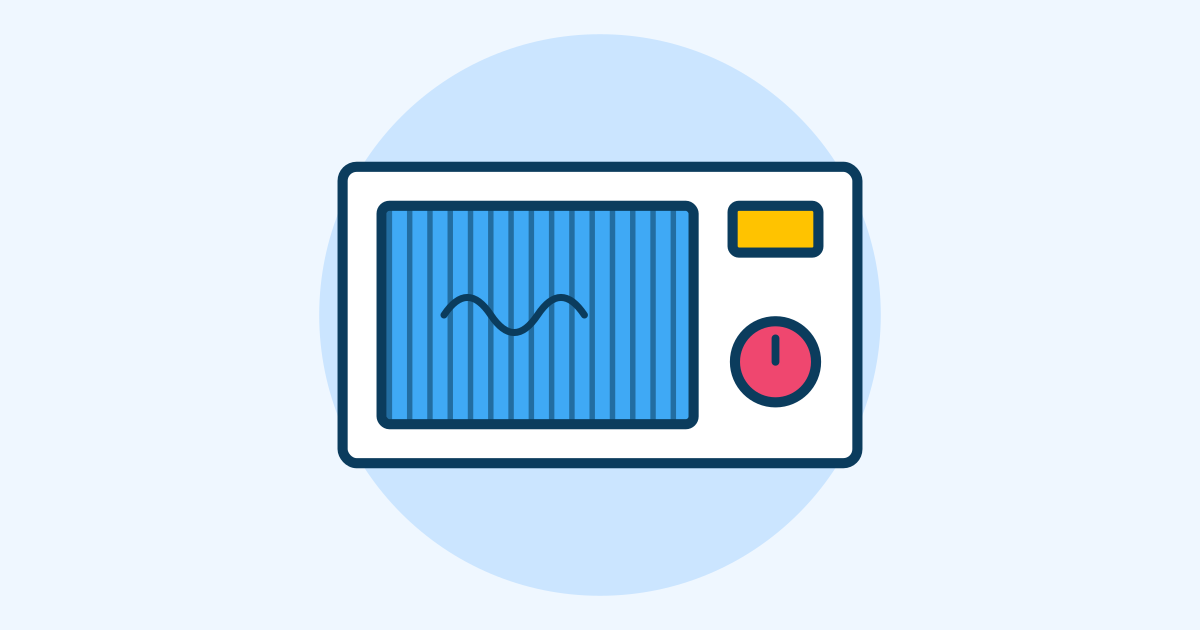
The metal mesh in the window is a Faraday shield. The holes are far smaller than the wavelength being used, so the waves cannot pass while visible light can, which is why you can watch your food and not be cooked by it.

Leakage is tightly regulated and the permitted amount falls off very quickly with distance. Stepping back a foot cuts your exposure by roughly three quarters, which is a large reduction of an already small number.

When to actually worry

The door is the thing to watch. A bent door, a damaged latch, a hinge that no longer closes flush, or a mesh with a hole in it. Those defeat the shield, and that is a genuine reason to stop using the oven rather than to stand further away.

Running it empty is also worth avoiding. With nothing to absorb the energy it reflects back into the magnetron and shortens its life.

So, the step back

Harmless, and unnecessary on an oven in good condition. Keep the habit if you like. Just check the door seal occasionally, because that is the part that actually matters.


Work & Career

Controlling Anger At Work

Controlling Anger At Work

Anger at work is common and reasonable. What it costs depends almost entirely on the ninety seconds after it arrives.

Controlling Anger At Work

Something will make you angry at work. A decision reversed without consultation, credit taken, a colleague who does not do what they said. The feeling is not the problem and suppressing it is not the goal.

What matters is a short window immediately afterwards.

The first ninety seconds are chemistry

The physical surge has a shape. It rises fast and, left alone, subsides substantially within a couple of minutes. What extends it is rehearsal, going back over the offence, which keeps re-triggering the response.

So the single most useful move is to not act and not rehearse for two minutes. That is a small ask and it is where most of the damage is prevented.

Never send the message

Write it if it helps. Do not put an address in the field. The clarity you feel while writing an angry message is not clarity, and it does not survive the following morning.

Anything sent in that state is permanent, forwardable, and read by people who were not there.

Separate the event from the pattern

Disproportionate anger is usually about the fifth instance, not the first. Worth knowing, because raising the fifth instance as though it were the first confuses everyone and makes you look unreasonable.

If it is a pattern, the conversation is about the pattern, and it needs to happen calmly and on a different day.

Say it plainly, later

Anger suppressed indefinitely does not disappear. It leaks as coldness, and colleagues can read that without being able to address it.

The version that works is direct, specific and unheated. When this happened, this was the effect. Delivered a day later, it lands. Delivered in the moment, it is noise.

Work & Career

Traits Of Great Leaders

Traits Of Great Leaders

The lists are long and mostly interchangeable. A few traits do the actual work, and they are less charismatic than advertised.

Traits Of Great Leaders

Leadership writing has a reliable failure mode. It observes successful people, lists their adjectives, and presents the list as a cause.

Strip out the traits that are really just descriptions of having succeeded, and a short and duller list remains.

Clarity about what matters

The first job is deciding what the group is actually optimising for and saying it often enough that people can make decisions without asking.

Most dysfunction is not disagreement. It is different people holding different unstated priorities and each behaving reasonably given theirs.

Consistency over brilliance

Teams organise themselves around what they can predict. A leader whose reaction to bad news is the same on Tuesday as on Friday gets told about problems early. One whose reaction varies gets told late, and lateness is what turns problems into failures.

This matters more than any individual decision quality, because it determines what information reaches you at all.

Taking blame and passing credit

The oldest one on the list and still the most reliable. It is also expensive in the moment, which is why it is rare.

Willingness to be wrong out loud

A leader who changes position when shown better information licenses everyone else to do the same. One who never does teaches the team that positions are defended rather than tested, and the whole group gets slower and worse.

What is not on the list

Charisma, which correlates with getting the job and not with doing it well. Vision, which is worth little if the week’s priorities are unclear. And decisiveness, which is a virtue only in someone who reliably changes their mind when the facts move.

Wonders & Trivia

Why We Are So Easily Influenced

Why We Are So Easily Influenced

We like to think we judge each argument on its merits. The research says we mostly judge the person making it, and we prefer people who resemble us.

Why We Are So Easily Influenced

Ask anyone how they form an opinion and you will hear something about weighing the evidence. Watch what actually happens and a different pattern shows up. We are far more persuaded by people who resemble us than by people who are right.

Similarity does the persuading

Studies keep finding the same thing. The same argument lands harder when it comes from someone who shares your background, your accent, your line of work, even your first name. Nothing about the argument changed. Only the messenger did.

It is not stupidity. For most of human history the people around you were the only reliable source of anything, and copying them was a sound survival strategy. The instinct is old and it is still running.

Confidence reads as competence

The second lever is certainty. A person who states something flatly is believed more readily than a person who states it accurately with caveats. This is why the most confident voice in a meeting often carries the room, and why the careful one who says it depends is heard as weak.

Worth knowing in both directions. It explains who you are believing, and it explains why your own well-hedged point keeps losing to someone with half your information.

Repetition works even when you know it is repetition

Something heard often enough starts to feel true. The effect survives knowing about it, which is the uncomfortable part. Familiarity is easy to mistake for evidence because both arrive as a feeling of ease rather than a conclusion.

What to do with this

The practical move is a small delay. When you notice yourself agreeing quickly, ask what the actual claim is, separately from who said it and how surely they said it.

You will not do this often. But agreement that arrives instantly is usually the copying instinct, not the reasoning one, and that is exactly the moment worth checking.

Work & Career

Getting Ready For A New Job

Getting Ready For A New Job

The first weeks set an impression that takes a year to revise. Most of what decides it happens before you walk in.

Getting Ready For A New Job

Preparation for a new job usually stops at the outfit. It is the least consequential item on a fairly short list.

Learn the dress code before you buy anything

Since it comes up first, deal with it quickly. Find out what the place actually wears rather than guessing upward. Overdressed is a smaller error than underdressed but it is still an error, and both are avoidable by asking one question.

Know what you were hired to fix

Every role exists because something was not happening. Sometimes it is stated in the description, often it is not. Ask directly at the offer stage. What does good look like at six months.

Arriving with that answer changes what you pay attention to in week one.

The first month is for questions

There is a window where asking anything is free, and it closes faster than people expect. Use it hard. Write down what you are told, because you will be told it once.

The temptation is to demonstrate value immediately by proposing changes. Almost every proposal made in week two is a suggestion the team already tried in a year you were not there for.

Map the informal structure

The org chart shows reporting lines. It does not show who is actually consulted before decisions, who has been there longest, or whose objection quietly stops things.

That map takes a month to draw and it explains most of what would otherwise be baffling.

Deliver one small visible thing early

Not a transformation. Something modest, finished, useful, inside the first six weeks. It buys the patience you will need for the larger work, and it is remembered far out of proportion to its size.

Work & Career

Being Professional At Work

Being Professional At Work

The rules are mostly unwritten, which is why people who miss them rarely find out until it has already cost them.

Being Professional At Work

Nobody hands you the list. Professional behaviour is learned by observation, and people who did not have it modelled early are judged against a standard nobody stated.

Time is the loudest signal

Arriving on time to meetings, and ending them on time, communicates more than most people realise. Habitual lateness is read as a statement about whose time matters, whatever the actual reason.

Same for deadlines. A thing delivered when promised, even imperfectly, builds more trust than a better version delivered late without warning.

Read the volume of the room

Every workplace has a register. How direct people are, how much disagreement is normal in a meeting, whether humour is welcome and of what kind.

Newcomers who match it fit quickly. The mistake is assuming your last workplace’s register is the universal one.

Written communication is where reputation forms

Most colleagues experience you mainly through messages. Replying within a reasonable window, writing clearly, saying what you need rather than hinting at it, closing the loop when something is done.

None of it is difficult. All of it is noticed, mostly in its absence.

Be the same person to everyone

The clearest professionalism signal there is. How someone treats the person who cannot help them is read carefully by everyone who sees it, and remembered longer than any presentation.

Own the mistake first

Raising your own error before it is discovered costs a bad ten minutes and buys years of credibility. Being found out costs the reverse, and the difference between the two paths is usually a single decision made in the first hour.

Work & Career

Common Mistakes We Make At Work

Common Mistakes We Make At Work

Most workplace errors are not carelessness. They are the predictable result of how attention behaves under routine.

Common Mistakes We Make At Work

Errors creep into the work of diligent people. That is worth stating plainly, because the usual response to a mistake is to try harder, and trying harder is not what fixes most of them.

Familiarity is where errors live

New tasks get attention automatically. Familiar ones do not, and that is precisely the point at which the wrong file gets attached and the old figure gets carried forward.

Which means the risky work is not the difficult work. It is the work you have done two hundred times.

Checking your own output does not work well

You read what you meant rather than what you wrote. This is not a character flaw, it is how reading works, and it is why proofreading your own document catches so little.

Distance helps. An hour, a printed copy, a different screen. Another pair of eyes helps more, and on anything that matters it is worth the small ask.

Interruption is the other main source

A task resumed after an interruption is frequently resumed one step further along than it actually was. The step that gets skipped is invisible precisely because you believe you did it.

The defence is boring and effective. Finish the small thing before answering the message, or leave yourself a marker.

Speed at the wrong moment

Most people are fast where care is needed and careful where speed would be fine. Sorting that out is worth more than a general resolution to be more careful.

The one that costs most

Not the error itself. The delay in reporting it. Almost everything is fixable early and expensive late, and the hour spent hoping nobody notices is the hour in which it stops being small.

Mind & Habits

Fixed Versus Growth Thinking

Fixed Versus Growth Thinking

Two beliefs about where ability comes from. They produce very different behaviour in front of something difficult.

Fixed Versus Growth Thinking

Ask someone whether intelligence is largely fixed or largely built and the answer predicts a surprising amount about how they will behave when something gets hard.

The two positions

One holds that ability is a quantity you have. Effort is then evidence of not having enough of it, because talented people find things easy.

The other holds that ability is mostly built. Effort is then simply the mechanism, and difficulty is the sensation of it working.

Neither is a personality. Most people hold one in some areas and the other elsewhere, which is worth noticing about yourself.

Where it shows

Not on easy tasks, where both look identical. It shows at the first real obstacle.

The fixed view reads a setback as information about the ceiling, so withdrawing is the rational response. The built view reads the same setback as information about the method, so adjusting is the rational response.

Same event, opposite conclusion, and over years the two accumulate into very different capability.

Praise pushes it either way

This is the practical part, especially with children and junior colleagues. Praising the person, you are so clever, attaches their identity to an outcome, which makes the next failure threatening.

Praising the approach, that was a good way to break the problem down, attaches it to something repeatable. The second holds up when things get difficult and the first does not.

The honest caveat

Belief is not unlimited. Effort will not make anyone anything, and the idea has been oversold in places where it turned into blaming people for structural problems.

The narrow claim is the defensible one. Within your actual range, what you believe about effort largely determines how much of that range you ever use.

Mind & Habits

Stop Being A People Pleaser

Stop Being A People Pleaser

It looks like kindness and it usually is not. Kindness is a choice, and pleasing is a reflex to avoid discomfort.

Stop Being A People Pleaser

People-pleasing is easily mistaken for a virtue, including by the person doing it. Agreeable, accommodating, always helpful. Hard to criticise from the outside.

The tell is what happens inside. Genuine generosity leaves you fine. Pleasing leaves resentment, and resentment is the signal that something was given which was not actually available.

It is fear management

The mechanism is avoidance of a specific discomfort. Someone being disappointed in you. Saying yes removes that instantly, which is the reward, and the cost arrives later when you have to do the thing.

Understood that way it stops looking like generosity and starts looking like what it is, which is a bill paid on credit.

Nobody knows what you actually think

This is the expensive part. If you agree with everyone, your agreement carries no information. People stop being able to read you, and the relationships get shallower rather than warmer, which is the opposite of what was intended.

Buy yourself an hour

The practical first move is not learning to say no. It is learning not to answer immediately. Let me check and come back to you is a complete response, and the hour is usually enough for the real answer to surface.

Most yes commitments are given in the first three seconds, and almost none of them survive an hour of thought.

Disappointing people is survivable

The thing being avoided turns out to be much smaller than it feels. Say no clearly and without excessive apology, and most people accept it, adjust and think no less of you.

The catastrophe rehearsed in advance almost never arrives, and finding that out once is worth more than any amount of resolve.

Mind & Habits

Focus On Doing One Thing

Focus On Doing One Thing

Multitasking feels efficient and measures badly. What it mostly produces is fatigue and a day with nothing finished.

Focus On Doing One Thing

Doing several things at once feels productive. That feeling is the problem, because it is generated by the activity rather than by the output.

You are not doing two things, you are switching

The brain does not run two demanding tasks in parallel. It alternates, and every alternation carries a cost. A fragment of the previous task stays active while you begin the next, so you start each one slightly degraded.

With small tasks the cost is small. With anything requiring real thought it is substantial, and it is invisible, which is why people keep paying it.

The tiredness is real and it is disproportionate

A day of constant switching leaves people more exhausted than a day of sustained difficult work, while producing considerably less. That combination is what burns people out, and they usually blame the volume rather than the fragmentation.

Boredom is the reason we do it

Worth being honest about. Single-tasking is often less interesting. The switch to the inbox is not efficiency, it is relief from the discomfort of one thing for a long time.

Which means the fix is partly about tolerating a mild unpleasantness rather than installing a system.

What actually helps

Blocks, with a defined start and end. One task per block, chosen in advance so no decision is required at the time. The other tasks visible on a list, because most switching is driven by the fear of forgetting something.

Notifications off for the duration. Not minimised. Off.

The measure to trust

Not how full the day felt. What is finished at the end of it. Those two diverge sharply, and only one of them is worth anything the following morning.